DENPASAR, lintasbali.com — The Indonesian Hotel General Manager Association (IHGMA) Bali Chapter is calling for a comprehensive review of fuel distribution governance and stronger crisis mitigation measures following disruptions to fuel availability and distribution across Bali that began on 11 October 2026.
The disruptions, marked by long queues at numerous fuel stations, have affected public mobility and raised concerns about the operational resilience of Bali’s tourism and hospitality industry, one of the main pillars of the island’s economy.
Although queues reportedly began to ease on 17–18 October following a series of response measures, IHGMA Bali believes the incident should serve as a critical turning point for strengthening supply preparedness, distribution efficiency, institutional coordination, public communication, and cross-sector crisis management.
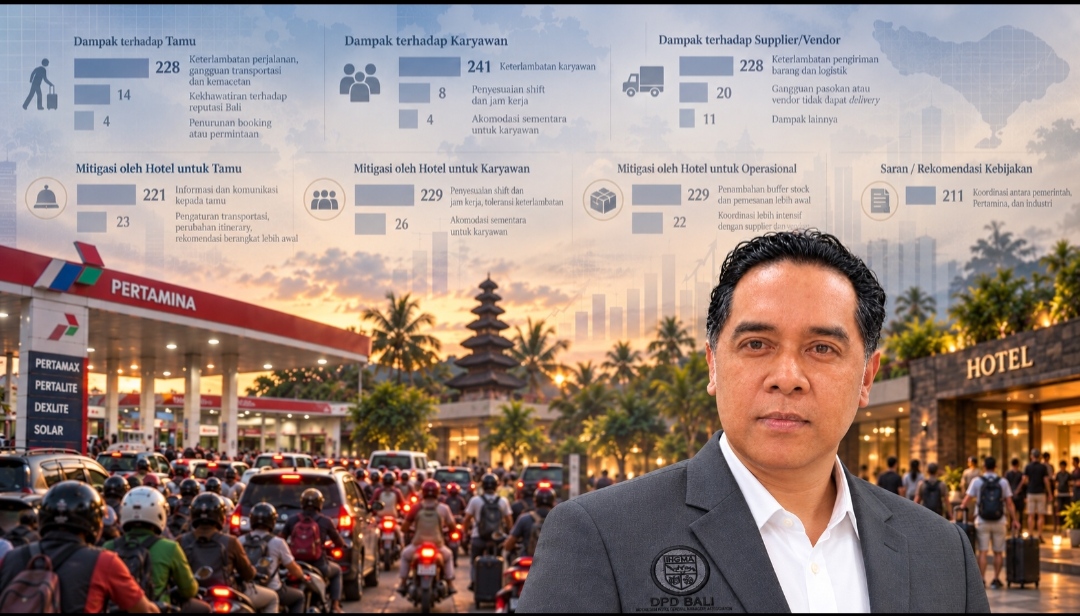
As an association representing hotel General Managers across Bali, IHGMA Bali conducted an internal survey among its membership network from 14 to 17 October 2026. The survey examined the operational impacts of the fuel disruptions, mitigation measures implemented by hospitality businesses, and recommendations for relevant policymakers and stakeholders. The compiled report recorded 259 responses for each question presented.
The findings were reviewed by IHGMA Bali’s leadership and advisory board as the basis for formulating the association’s official position, with a focus on public interests, industry resilience, and the long-term sustainability of Bali as an international tourism destination.
On 12 October 2026, the Governor of Bali expressed optimism that fuel distribution issues could be resolved promptly following coordination with Pertamina. However, long queues and service disruptions continued at several fuel stations in the following days.
On 13 October, Pertamina attributed delays to technical difficulties involving a tanker preparing to unload its cargo. On 14 October, the government and Pertamina reiterated that fuel stocks at Bali’s storage terminals remained sufficient.
Meanwhile, media reports on 14–15 October highlighted additional response measures, including phased shipments from Surabaya and the deployment of four fuel tanker trucks from Banyuwangi to Bali.
These developments highlight a critical distinction: sufficient fuel stocks at storage terminals do not automatically guarantee timely distribution to fuel stations or actual availability for consumers.
Moving forward, public information must clearly distinguish between terminal stock levels, incoming supply schedules, distribution capacity, and fuel availability at individual stations. Such information should be accurate, consistent, and regularly updated to reduce uncertainty, discourage panic buying, and prevent speculation.
Extending fuel station operating hours can help improve public access to fuel during periods of disruption. However, round-the-clock operations require adequate staffing, well-planned shifts, sufficient rest periods, occupational safety measures, and effective systems for managing queues and public complaints.
Field conditions indicate that staffing capacity and operational arrangements cannot always be expanded immediately. Extended working hours, physical exhaustion, emotional pressure, and crowded queues can place significant demands on fuel station personnel and increase the risk of tension between attendants and customers.
IHGMA Bali emphasizes that extended operating hours must be supported by adequate personnel, appropriate workforce planning, security assistance, and effective traffic management. Maintaining distribution continuity should not depend solely on asking frontline workers to work longer hours.
Several mitigation measures were introduced during the disruption, including work-from-home arrangements, online learning, odd-even vehicle restrictions, fuel purchase limits, additional supplies, and the deployment of security personnel to support distribution.
However, these measures appeared after queues and public concerns had already spread to multiple locations.
IHGMA Bali recognizes that emergency policies require careful operational planning and coordination across institutions. Nevertheless, this incident underscores the need for predefined mitigation protocols that can be activated progressively according to measurable indicators, such as increasing waiting times, declining fuel availability at stations, or disruptions to transportation and logistics services.
Measures involving remote working, traffic management, purchase restrictions, and personnel deployment should be guided by impact assessments, clear activation criteria, cross-sector coordination, and regular evaluation.
A proactive approach would allow authorities to reduce pressure before disruptions escalate into a broader public and economic crisis, rather than relying primarily on reactive measures.
When queues lengthen and public anxiety rises, the visible presence of leaders and relevant officials on the ground becomes essential. Such engagement must go beyond symbolic expressions of concern and contribute directly to faster decision-making, operational problem-solving, and coordinated action.
IHGMA Bali appreciates the Governor of Bali’s direct engagement with the public during this challenging period. At the same time, the association believes that crisis response would be more effective if relevant officials and key stakeholders were also present at affected locations, ensuring that responsibilities are shared and operational problems are addressed promptly.
Clear divisions of responsibility are needed among the regional government, Pertamina, security authorities, fuel station operators, and other relevant agencies. Field coordination should prioritize queue management, the removal of distribution bottlenecks, adequate operational support for fuel station personnel, and the delivery of accurate, accountable information.
Effective coordination must ensure that frontline workers have the staffing, security, and resources needed to serve the public safely and efficiently throughout a crisis.
Fuel disruptions lasting several days attracted widespread attention through mobile phone recordings, news coverage, and social media, including international media outlets. Reports of long queues, tourists losing valuable travel time, and interruptions to daily activities can influence perceptions of Bali’s accessibility, convenience, and overall visitor experience.
IHGMA Bali believes that crisis communication must extend beyond general assurances that fuel stocks are sufficient. The government, Pertamina, and tourism stakeholders should proactively communicate practical, location-specific information, including operating fuel stations, confirmed availability, distribution arrangements, expected recovery timelines, and guidance for residents and visitors.
Tourism authorities and industry associations should also help disseminate verified information to hotels, travel agents, drivers, transport operators, airlines, and tourists.
A coordinated communication system would help reduce uncertainty, limit the spread of unverified information, and enable businesses and visitors to make informed decisions.
Periods of supply disruption can create opportunities for fuel hoarding, unauthorized distribution, and resale at unreasonable prices. Where such practices are suspected, monitoring and enforcement must be conducted on the basis of evidence and in accordance with applicable regulations.
IHGMA Bali calls for accessible public reporting channels, stronger oversight of fuel distribution, and transparent follow-up on suspected violations.
These measures are necessary to protect equitable public access to fuel, prevent consumer exploitation, and restore confidence in the distribution system.
The IHGMA Bali internal survey identified several significant operational impacts on hotels and hospitality businesses.
1. Disruptions to Tourist Mobility
A total of 228 responses reported travel delays, transportation disruptions, and traffic congestion.
These conditions can affect airport transfers, guest pick-up arrangements, journeys to tourist attractions, and scheduled tourism activities. Delays may also complicate coordination between hotels, drivers, travel agents, and other tourism service providers.
2. Disruptions to Workforce Attendance
A total of 241 responses reported employee lateness.
Hospitality operations depend on shift-based staffing and continuous service delivery. When employees arrive late, on-duty teams may face additional workloads, shift handovers can be disrupted, and service speed and consistency may be affected.
These challenges demonstrate how transportation disruptions can quickly translate into operational pressure within hotels and other tourism businesses.
3. Supply Chain and Logistics Disruptions
A total of 228 responses reported delays in goods deliveries and logistics, while 20 responses indicated supply disruptions or vendors being unable to deliver.
Such disruptions may affect the availability of food and beverages, linen, cleaning supplies, and other essential hotel operating materials. If prolonged, these constraints could increase operating costs and complicate inventory management.
4. Wider Operational and Reputational Concerns
Beyond these primary impacts, the survey recorded:
- 215 responses under the category of other impacts, indicating disruptions to internal operations and mobility.
- 14 responses expressing concern about Bali’s image or reputation as a tourism destination.
- 4 responses indicating the potential for declining bookings or demand.
These figures represent response frequencies from the internal survey and should not be interpreted as estimates of the proportion of all hotels in Bali affected. Nevertheless, they indicate that fuel distribution disruptions can extend beyond transportation, affecting workforce management, supply chains, guest experiences, and perceptions of destination reliability.
International coverage by media outlets including the Associated Press, Channel News Asia, the South China Morning Post, and Euronews on 14 October 2026 also illustrates the incident’s international visibility.
For Bali, where destination reputation is closely linked to visitor confidence and the reliability of tourism services, effective crisis management and timely recovery are essential to maintaining the trust of tourists, travel partners, and international markets.
The internal survey indicates that hotels and hospitality businesses implemented various measures to maintain service continuity and minimize the impact on guests, employees, and daily operations.
1. Protecting Guest Experience and Comfort
The most frequently reported mitigation measure was providing guests with updated information and communication, recorded in 221 responses.
A further 23 responses cited transportation arrangements, itinerary adjustments, and recommendations for guests to depart earlier.
These measures help visitors anticipate travel-time changes, adjust their schedules, and obtain clearer guidance on transportation options. Timely communication is particularly important when guests have airport departures, scheduled excursions, or other time-sensitive commitments.
2. Maintaining Workforce Continuity
A total of 229 responses cited adjustments to shifts and working hours, together with flexibility regarding employee lateness, as key mitigation measures.
Another 26 responses mentioned providing temporary accommodation or places for employees to stay overnight.
Flexible scheduling and temporary accommodation can help employees reach the workplace more reliably, reduce commuting pressures, and maintain service continuity. Such measures also reflect the importance of considering employee welfare as part of operational resilience.
3. Securing Operational Supplies and Strengthening Supply Chains
A total of 229 responses cited increasing buffer stock and placing orders earlier, while 22 responses highlighted closer coordination with suppliers and vendors.
These measures demonstrate the importance of inventory planning, proactive supplier communication, and alternative sourcing arrangements when delivery schedules become uncertain.
Overall, the survey suggests that hospitality businesses did not simply wait for conditions to return to normal. They adjusted staffing, guest communication, transportation arrangements, and procurement practices to protect service quality.
However, the capacity to implement these measures varies according to business size, available resources, and operational characteristics. Stronger coordination and cross-sector support therefore remain essential to ensuring that businesses of different scales can respond effectively to future disruptions.
Based on the survey findings and its assessment of the incident, IHGMA Bali puts forward the following recommendations to the government, Pertamina, and relevant stakeholders.
1. Strengthen Fuel Demand Forecasting and Reserve Preparedness
The government and Pertamina should improve fuel demand planning based on actual consumption patterns, population mobility, tourism activity, transportation requirements, and logistics demand.
Adequate reserve mechanisms, alternative supply routes, contingency delivery schedules, and emergency distribution plans should be established to anticipate technical failures, shipping delays, and other supply chain disruptions.
2. Establish a Transparent and Accessible Fuel Information System
Official information on fuel availability, operating fuel stations, delivery schedules, distribution arrangements, and recovery measures should be updated regularly and disseminated through accessible digital channels.
The information system must distinguish between stock availability at storage terminals and actual availability at individual fuel stations. Where possible, updates should include verified station-level information and clear guidance for residents, businesses, and visitors.
Transparent information would enable better decision-making, reduce uncertainty, and help prevent unnecessary panic buying.
3. Institutionalize Coordination Between Government, Pertamina, and Industry
A total of 211 responses emphasized the importance of coordination among the government, Pertamina, and industry.
IHGMA Bali recommends establishing a formal crisis coordination mechanism involving regional government authorities, fuel distribution operators, security agencies, tourism associations, transport operators, logistics providers, and hospitality industry representatives.
This mechanism should define clear responsibilities, communication channels, escalation procedures, and decision-making authority before a crisis occurs.
4. Develop Early-Activation Crisis Mitigation Protocols
Crisis mitigation protocols should establish measurable activation indicators, designated responsibilities, public communication procedures, queue management arrangements, personnel support, and regular evaluation mechanisms.
Emergency measures should be introduced proportionately according to verified conditions and their potential impact on communities and economic activities.
Regular simulations and post-incident evaluations should also be conducted to identify operational weaknesses and improve institutional readiness.
5. Strengthen Distribution Oversight and Law Enforcement
Monitoring of suspected fuel hoarding, distribution irregularities, and resale at unreasonable prices should be strengthened in accordance with applicable regulations.
Authorities should provide clear reporting channels, transparent verification procedures, and timely follow-up on credible reports. Enforcement should be evidence-based and consistently applied to protect public access and confidence in the distribution system.
6. Protect Essential Transportation, Tourism, and Logistics Operations
During supply emergencies, the government should assess the feasibility of a transparent, needs-based fuel distribution mechanism for essential services, including healthcare, emergency response, public transportation, food logistics, and critical tourism operations that directly affect visitor services.
Any prioritization must be based on verified operational needs, clear criteria, and regular oversight. It must also preserve equitable public access to fuel and avoid creating unjustified advantages for particular sectors or businesses.
7. Establish Integrated Tourism Crisis Communication
The government and tourism stakeholders should establish an integrated crisis communication mechanism, coordinated through designated public information or public relations liaison officers within the relevant regional government agencies.
The mechanism should function as a central coordination hub for accurate, consistent, timely, and practical information reaching tourists, hotels, travel agents, airlines, transportation providers, and international travel partners.
Official communication channels should provide regular updates on developments, response measures, service conditions, and practical guidance for visitors and businesses.
Tourism industry associations, including IHGMA Bali, should be formally involved in disseminating verified information to their respective networks.
A coordinated communication framework would help minimize uncertainty, prevent conflicting messages, strengthen public confidence, and protect Bali’s reputation as a reliable international tourism destination.
IHGMA Bali emphasizes that the fuel distribution disruption in October 2026 was not merely a question of energy availability. It also tested the resilience of distribution systems, institutional coordination, crisis communication, workforce readiness, and the operational continuity of sectors that depend on mobility.
The association appreciates the efforts undertaken by the government, Pertamina, security authorities, and businesses to accelerate service recovery and ease the pressure on the public.
However, the gradual easing of queues should not mark the end of the evaluation process. The lessons from this incident must be translated into concrete improvements in supply preparedness, distribution governance, inter-agency coordination, public information systems, and crisis mitigation protocols.
As a professional association representing hotel leaders across Bali, IHGMA Bali stands ready to collaborate with the government, Pertamina, and all relevant stakeholders to strengthen crisis preparedness, maintain hospitality service continuity, safeguard public interests, and support the long-term sustainability of Bali’s tourism industry.
Bali’s standing as a world-class tourism destination must be supported not only by its natural beauty, culture, and hospitality, but also by reliable infrastructure, transparent governance, resilient supply chains, and effective crisis management.
IHGMA Bali believes that building these capabilities is a shared responsibility and a necessary investment in Bali’s future as a sustainable, trusted, and internationally competitive tourism destination. (Rls)